Node
Sensor
An STM32-class microcontroller reads the sensors fitted for that site and stays asleep between readings, which is what makes the power budget work.
Technology
Remote monitoring usually fails on one of two things: getting data out of deep cover, or keeping hardware alive without a service visit. Nature Guards is designed around both constraints.
Node
An STM32-class microcontroller reads the sensors fitted for that site and stays asleep between readings, which is what makes the power budget work.
Radio
Long range at very low power, reaching kilometres through terrain that defeats Wi-Fi and where cellular coverage does not exist.
Bridge
LoRa traffic is converted to Ethernet, putting the whole network's readings onto standard IP infrastructure.
Decision
AI analyses readings for trends and anomalies across the network; human monitors judge what deserves a response on the ground.
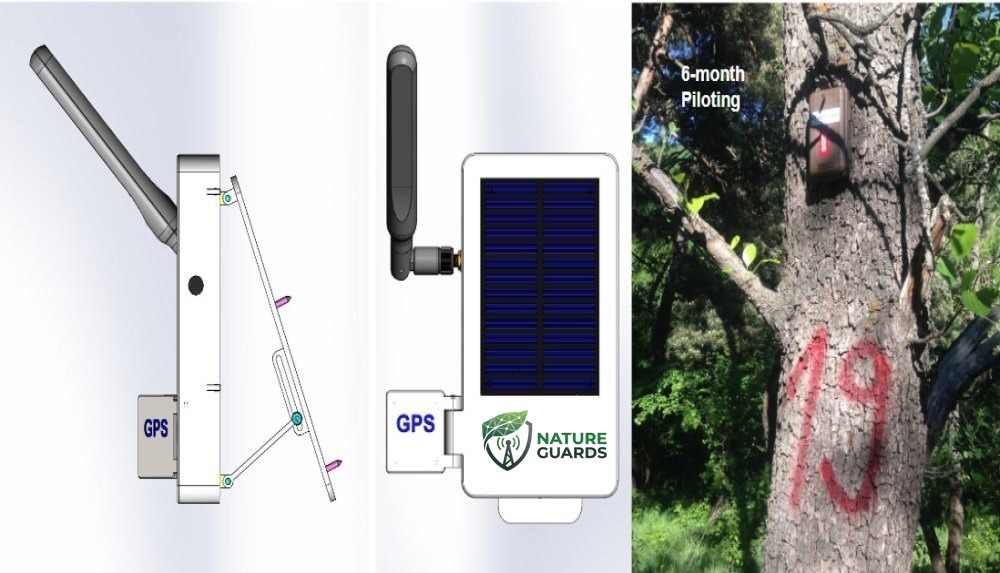
Not a render of a plan. The unit on the right ran for six months strapped to a trunk in the Stepanavan pilot, through an Armenian winter, powered only by the panel on its face.
Cellular needs coverage that rarely reaches into managed forest, and the radios draw far too much power for a node expected to last years. Wi-Fi and mesh protocols lack the range once trees and terrain are in the way. Satellite works but costs per message and per node in a way that does not scale to hundreds of sensors.
LoRa's bandwidth is tiny. That is irrelevant here: an alert is a few bytes — which sensor, what reading, when. Trading throughput for range and power draw is exactly the right trade for this problem.
Nodes are configured per deployment. A dry-season fire-risk site and an anti-logging boundary draw on different subsets of the same family.
Saw noise, engine noise, human activity
Flame and hotspot signatures
Abnormal heat rise against baseline
Ambient trend, frost risk, fire conditions
Soil and air dryness — irrigation need, and fire load
Movement of people, vehicles and machinery
Planning a deployment, or want the detail behind these figures? Get in touch.